AI won’t replace accountants. But the next decade will reinvent them, and All Nations University is building that graduate now.
By 2030, the World Economic Forum expects accounting, bookkeeping and payroll clerks to be among the fastest-declining roles on earth.
So here is the question every accounting student should be asking, and most are not:
If the work that defines the job today is disappearing, what exactly am I training for?
At All Nations University, we believe the honest answer is also the most exciting one in the profession’s history. The accountant is not being made redundant. The clerk inside the accountant’s job is, and what remains is more valuable, more strategic, and more human than ever.
The shift, stated plainly
There is a phrase circulating in professional circles: AI will not replace you, but someone who knows how to use AI will. It is true. It is also incomplete.
The real change is structural. The World Economic Forum’s Future of Jobs Report 2025 projects that by 2030, only about a third of workplace tasks will be performed by humans alone, down from nearly half today, with the rest automated or handled through human–machine collaboration. Routine ledger work, transaction processing and data entry are moving decisively to machines.
But the same report points the other way for higher-order work. Regulatory and compliance roles are growing. Advisory, assurance and judgment-intensive work is expanding. Roughly 39% of the average worker’s core skills are expected to change by 2030, and analytical thinking now tops the global list of in-demand capabilities.
Read together, the message is unambiguous: the routine is being automated; the judgment is being rewarded. The accountant who survives 2046 is the one trained for the second category, not the first.
The routine is being automated; the judgment is being rewarded. The accountant of 2046 is trained for the second category — not the first.
So what does the accountant of 2046 actually do?
This is where most “future of work” articles go vague. Let us be specific.
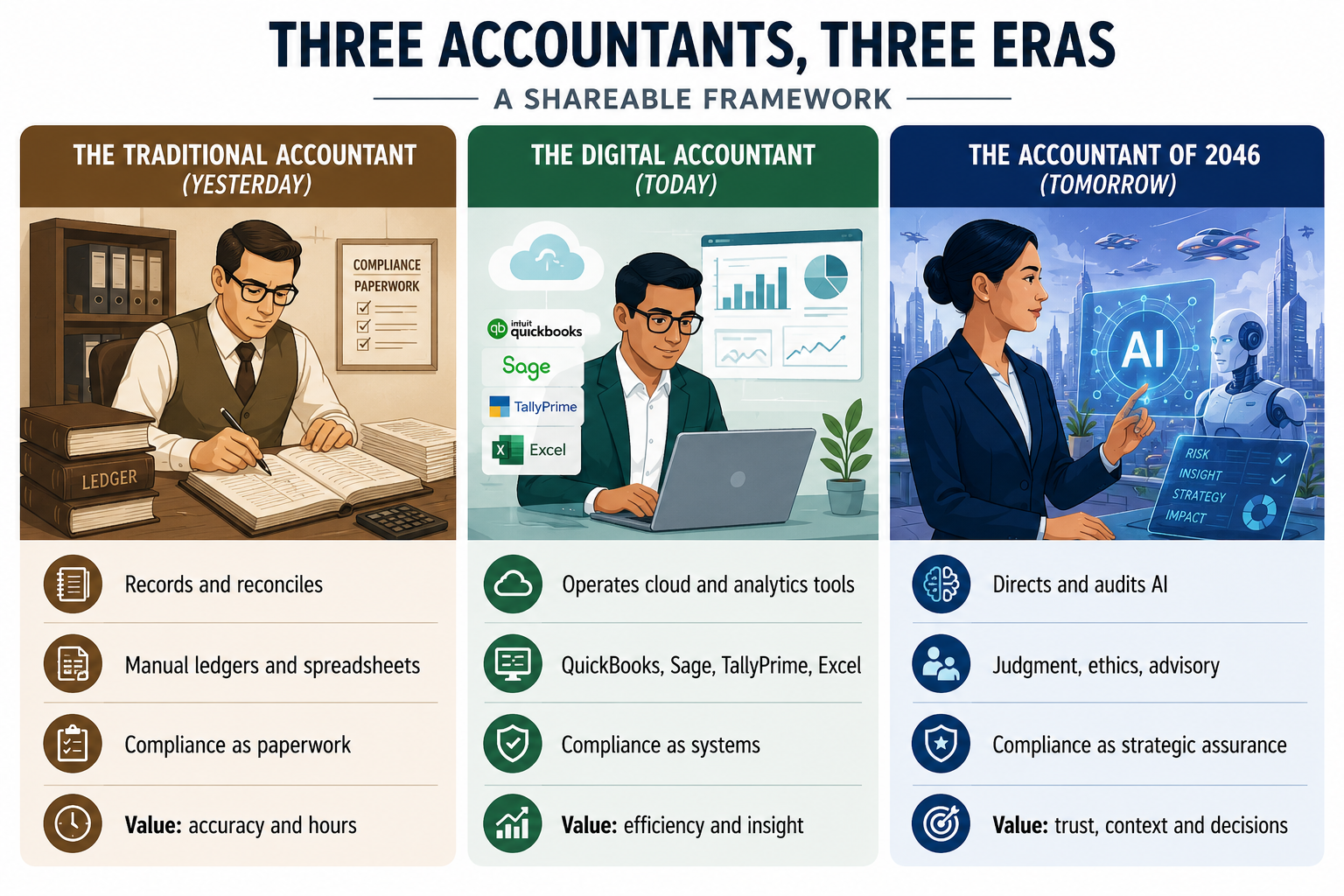
Picture a Tuesday morning, twenty years from now. The reconciliations are already done; an AI system closed the books overnight and flagged three anomalies. Our 2046 accountant does not re-key the numbers. She interrogates them: Is anomaly two a genuine risk, or an artefact of how the model was trained on data that never reflected a Ghanaian SME’s seasonal cash cycle? She advises a founder on whether an AfCFTA expansion is financeable. She signs off on an ESG disclosure, staking her professional integrity on a judgment no algorithm can be held accountable for.
The accountant of 2046 is, in order of importance: an ethical guardian of data and disclosure integrity; a strategic advisor who translates numbers into decisions; an interpreter who knows when a global model does not fit a local reality; and a technologist fluent enough in AI to direct it rather than fear it.
Technical fluency is the floor. Judgment is the building.
What All Nations University is doing differently
Our motto, Equipped for every good work, is not a slogan here; it is a curriculum design principle. Equipping the digital accountant begins long before graduation day. Here is how.
1. Hands-on fluency in the tools of practice. Students train on the platforms that define modern accounting, QuickBooks, TallyPrime, Sage, data-analytics tools and Excel-based financial statement preparation, so they contribute from their first day in a professional environment, not their first year.
2. Teaching through AI, not merely about it. AI is not a standalone topic at ANU; it is a method of delivery across courses, reinforced by annual faculty-development retreats on themes such as Academic Excellence in the ChatGPT and AI-Enabled Digital Era. Students are taught to navigate, interrogate and apply AI responsibly, to ask where a tool’s assumptions come from and when they fail. AI literacy is treated as a core competency, exactly as spreadsheet proficiency became essential a generation ago.
3. Industry voices in the room. Students learn from the professionals shaping the field, not textbooks alone. Our most recent Accounting Department seminar tackled a defining question head-on: Artificial Intelligence and the Future of Auditing — Implications for Professional Competence and Career Sustainability.
We are now in the era of AI as accountants,and to stand out and remain competitive, it is essential to adopt and effectively utilize AI tools. Mr. Maxwell Akrobettoe-MBA,CA, CIT.
4. Counselling on the whole arc of a career. Beyond technical skills, students are guided on certifications, career pathways, further study and personal brand. The results are measurable: a recent departmental tracer study found that roughly 60% of our accounting graduates progress directly into graduate school or professional certification, evidence of an institution producing lifelong learners, not just job-ready hires.
Joan Phyliis Somevi-MBA Accounting student
5. Final-year research that contributes, not just consumes. Graduating students investigate AI and its frontiers through formal research. This is the point most easily missed and most important: our students are not training to import a digital-accounting template designed elsewhere. They are training to shape what that template should be in African institutional realities, different regulatory environments, different financing structures, different data. Their findings add a Ghanaian perspective to a global conversation that badly needs it.
Our students are not training to import the future of accounting. They are training to help write it, from Africa.
A message to students: you are the actors, not the audience
You are studying accounting at the most consequential moment in the profession’s history. Whether the 2046 accountant is a passive tool-user or a confident, ethical strategist will be decided by what you do now, in lecture halls, workshops, research projects and the professional networks you build today.
The competitive advantage of 2046 is being built in 2026. We provide the environment, the exposure and the encouragement. The rest is yours to own. The best accountants of the next twenty years will be perpetual works-in-progress, always evolving, always growing, always relevant.
At All Nations University, we are not waiting for the future of accounting to arrive. We are helping to build it, one student at a time.
Over to you: If routine accounting work is automating and judgment work is growing, what one skill should every accounting programme be teaching today that it isn’t? I’d genuinely like to hear from students, educators and practitioners in the comments.
Subscribe to The ANU Brief for monthly perspectives from All Nations University on the future of higher education, technology and the professions.
#FutureOfAccounting #AIinEducation #HigherEducation #Ghana #Accounting #DigitalSkills #AllNationsUniversity #FutureOfWork