Why is it commonly argued that classroom education in this region remains largely theoretical, with limited practical application?
The title of this issue, ‘It is the lecturer, not the student’, is the response I received from Rev. Dr. Samuel H. Donkor, Vice-Chancellor of All Nations University, upon asking why it is commonly argued that classroom education in this region remains largely theoretical, with limited practical application. I rephrased the same question on another occasion, but the response was the same: ‘It is the lecturer, not the student’.
The phone call
A few years ago, I received a call from an institution involved in secondary education in Ghana. The institution was assembling experts in different fields to develop content for classroom activities in secondary schools. It was a great feeling to be considered for such a national assignment. The caller specifically used the word ‘expert’, and that awakened in me a great sense of responsibility.
Preparing for the national assignment
A date was fixed for the first meeting of the assignment, which they called the orientation seminar. As the ‘expert’, I was determined not to let anyone encroach on my field, whether in terms of unanswered questions or depth of content. Days before the scheduled date, I revisited one of the most prominent textbooks in my field, Wertz, Everett and Puschell (eds.), Space Mission Engineering: The New SMAD, and began revising my notes. I did all I could to build confidence for any possible technical interview. In addition, I decided to carry that big book along. SMAD is so big and heavy that it almost doubled the weight of my luggage. If you are a space systems engineering student and you do not have this 1,000-page book, you have not yet started the journey into space.
The Showdown and Self-Examination
Dressed in my pine-green suit with my necktie well knotted, as an alumnus of All Nations University, and with my SMAD book close by, I felt confident as I took my seat in the seminar. A professor was called up to give the first presentation, which was on pedagogy. Three slides into his lecture, I had to admit that I knew little to nothing about what he was delivering. The lecture had nothing to do with my SMAD. The seminar was not so much about subject technicalities as about how these technicalities can be well-structured and delivered in the art of effective teaching and learning. Concepts such as Bloom’s Taxonomy, Webb’s Depth of Knowledge, the Zone of Proximal Development (ZPD), and Scaffolding emerged. In that humbling moment, I began to lay down my armour and soberly open myself to learning something new. This experience prompted an honest self-examination: have I been lecturing my courses the wrong way? To some extent, yes. Do I have proficient knowledge in the courses I teach? Yes, I do. So, what is the gap? What I lacked was the art of effective pedagogy.
Pedagogy Is an Art: It Must Be Learned
Effective pedagogy is independent of the instructor's depth of technical knowledge in a subject. This is the most missed point. It is not actualized by mere passion to teach, nor is it a talent. Though these may have their place, effective pedagogy is an art that must be learned, practised, and refined. A skilled musician demonstrates this art on stage, reading the audience, changing tone, changing tempo, or ultimately changing the song to improvise. Art requires creativity, but would anyone have been able to convince me, with my 1,000-page SMAD book, that I needed an extra skill to effectively instruct my class? Such, I believe, is the plight of many instructors in our classrooms. Untrained instructors may remain mechanical in their delivery, failing to practise an established and effective art of teaching.
Pedagogy Is a Science: It Must Be Applied
A common motion for debate around this topic is whether teachers are made or born. My response is brief: a teacher may be born, but an effective teacher is made. Pedagogy is not just about goodwill to teach. It is a science because it has principles, methods, and theories that have been tested and proven. The principles of learner psychology, readiness, individual differences, maturation, reinforcement, feedback, learning environment, active participation, and so on, cannot be derived from passion, talent, goodwill, or technical depth in a subject. For example, passion alone is not enough to deploy the very rudiments needed to determine the cognitive levels of learners.
The Survey
In September 2026, I conducted a survey in a renowned higher education institution (anonymous) in Ghana to assess the deployment of some principles of effective pedagogy. The objective was to assess students’ perceptions of how consistently their instructors apply these principles. Informed consent was obtained from all participating students before the survey. Participation was voluntary and anonymous. The study adopted a descriptive survey design of a quantitative nature. The population comprised students irrespective of their class or programme. A voluntary-response sampling technique was used. The questionnaire was distributed via Google Forms, and students who chose to participate completed it voluntarily. Data were collected at a single point in time using a structured questionnaire for cross-sectional data collection. The sample size was 100.
Principles Assessed
It is important to introduce the principles used for this evaluation. Ten principles, which cover a full learning process, from initial cognitive preparation to practical application and long-term skill retention, were used. For each principle, the questionnaire item administered to the student is presented.
1. Principle of Readiness: “Do your teachers ask questions about previous lessons and connect new topics to what you already know?”
2. Principle of Learning Environment: “Do your teachers make the classroom safe, friendly and free, so you are not afraid to ask questions or make mistakes?”
3. Principle of Active Participation: “Do your teachers use different teaching methods, such as demonstration, group discussions and group work, and not only delivering their lecture notes?”
4. Principle of Motivation: “Do your teachers connect lessons to your future career and life goals?”
5. Principle of Reinforcement: “Do your teachers praise, encourage and motivate you when you do well or when you try?”
6. Principle of Maturation: “Do your teachers give enough time for students to understand before moving on?”
7. Principle of Feedback: “Do your teachers correct your mistakes quickly and return your classwork and test scripts on time with comments?”
8. Principle of Individual Differences: “Do your teachers consider your academic strengths and consider that students learn at different speeds, and give extra help where needed?”
9. Principle of Repetition: “Do your teachers revise important topics again and again for better memory?”
10. Principle of Concreteness: “Do your teachers take you outside the classroom or use field examples where possible?”
Survey Summary Results
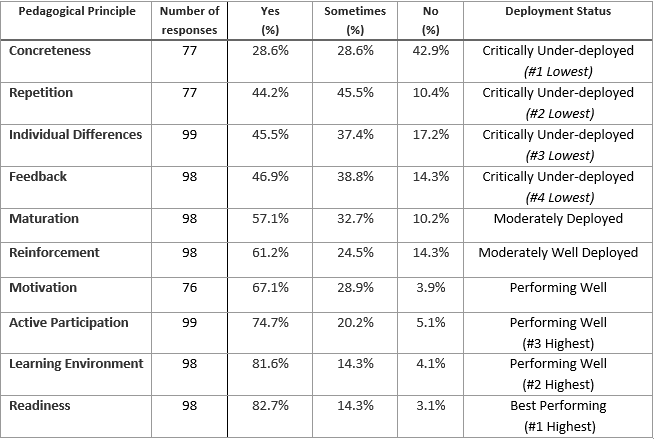
For this descriptive analysis, principles with fewer than 50% of valid responses in the 'Yes' category are classified as critically under-deployed. Although the survey analysis includes a sample of 100 students, some questions received fewer answers. Percentages therefore use the number of valid responses for each item. The results are presented below, ranked by the proportion of 'Yes' responses.
Summary Analysis
The survey provides insight into students' perceptions of teaching practices at the institution surveyed. Encouragingly, respondents reported relatively consistent application of several foundational principles. Readiness was rated highest, with 82.7% indicating that lecturers connect new topics to earlier lessons. Learning Environment also received a favourable rating (81.6%), followed by Active Participation (74.7%). Motivation (67.1%), Reinforcement (61.2%) and Maturation (57.1%) likewise received majority 'Yes' responses.
Four principles fell below the study's 50% benchmark: Feedback (46.9%), Individual Differences (45.5%), Repetition (44.2%) and Concreteness (28.6%). Concreteness was the lowest-rated principle; 42.9% of valid respondents selected 'No' when asked about field experiences or practical examples. These findings point to opportunities to strengthen practical application, timely feedback, individualised support and structured revision.
Because participation was voluntary and the results reflect student perceptions at one institution, they should be interpreted as indicative rather than representative of higher education teaching generally. Nevertheless, they invite reflection on how lecturers translate subject expertise into learning experiences that enable students to apply and retain knowledge.
Conclusion: It is the Lecturer, Not the Student
Effective teaching requires more than mastery of subject matter. It calls for deliberate attention to how students learn, how knowledge is communicated and how theoretical understanding becomes practical competence. The survey findings, although limited to respondents' perceptions in one institutional setting, offer a useful invitation to reflect on pedagogical practice. Principles such as Readiness, Active Participation, Feedback, Individual Differences and Concreteness should inform everyday classroom decisions rather than remain abstract concepts.
Students also bear responsibility for their learning. Yet lecturers play a central role in creating the conditions in which students can engage, understand, apply and retain knowledge. The challenge is therefore not simply to teach more content but to teach more effectively. In this spirit, 'It is the lecturer, not the student' is best read not as an assignment of blame, but as a call to professional responsibility, continuous improvement and pedagogical excellence.